
Should I use UV resin or epoxy resin for my project?
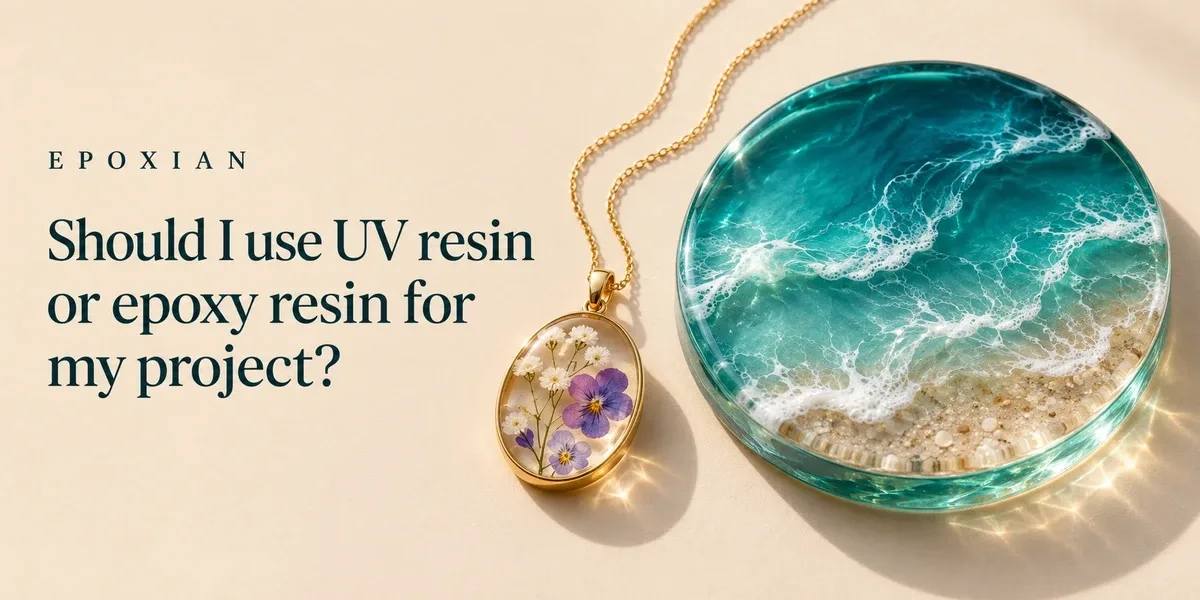
Choose UV resin for a thin, clear piece you can light from every angle it needs. Choose two-part epoxy resin for a coaster, a tray, or a casting where colour or a mould blocks the light. Think of the two pieces on the cover. A pressed-flower pendant needs only a few drops for its glossy face. An ocean coaster needs enough resin to fill a mould and enough working time to shape the white wave. Those are two different jobs.
UV resin vs epoxy resin at a glance
| What matters | UV resin | Two-part epoxy resin |
|---|---|---|
| What starts the cure? | Light from a compatible UV or UV-LED lamp. | Mixing the resin and its matching hardener in the stated ratio. |
| How long do I have? | Position a small detail away from curing light, then cure it in place. A thin layer can take minutes. | The working time starts when you mix. Check the kit for working time, demould time and full cure. |
| Which mould works? | A shallow, light-transmitting mould, or an exposed surface the lamp can reach. | Clear or opaque moulds, within the formula’s maximum pour depth. |
| What would I make? | A clear dome on a charm, a pair of stud earrings or a thin pendant. | A set of coasters, a trinket tray or a thicker cast keychain. |
For jewellery and keychains, look at the thickest part
For a flower pendant like the one pictured, start with the bezel. If the dried flower lies flat and a shallow clear layer will cover it, UV resin gives you time to turn the flower until you like its position. Work in thin layers as directed on the bottle. A metal back blocks light from below, so a broad petal can leave resin in shadow. For a chunky pendant with an embedded bud, choose a casting epoxy rated for the depth.
The same decision applies to keychains. A few drops of UV resin can give a flat initial a glossy face. A solid alphabet keychain filled with opaque blue pigment is a better job for epoxy. Even a small letter can have a deep stroke where light cannot reach. For occasional charms, Epoxian’s 25 g UV resin is a small bottle to start with. Check that your lamp matches the resin before you buy.
For coasters and trays, work from the mould dimensions
Say your round coaster mould measures 9 cm across on the inside and you want a 5 mm pour. A plain, flat circle that size holds about 32 mL. A matching set of four needs about 128 mL before mixing losses. That estimate helps you choose a kit and plan how many coasters to pour at once. If your kit is sold in grams, use its stated coverage or mixed density to convert the volume.
For an ocean design, lay out the mould and colours before mixing so you can use the working time to shape the wave. Epoxian’s 750 g art resin and hardener kit specifies two parts resin to one part hardener and lists a cure time of 24–48 hours. Use the measuring method on your kit and check its pour-depth limit. Before placing a hot mug on a finished coaster, check the resin’s full-cure instructions and service-temperature rating. For the pouring sequence, see how to make resin coasters at home.
Which resin costs less for my project?
For one pendant, the useful comparison is the cost of a small bottle plus a compatible lamp if you don’t own one. For a set of coasters, compare the cost of enough mixed epoxy to fill all four moulds. Two kits with different pack sizes are easier to compare if you divide each price by the total usable quantity in the same unit. Include both bottles when counting the contents of an epoxy kit.
Two checks before you pour
- For UV resin, test your darkest detail. Make a sample with the same mould, colour and layer thickness. Follow the lamp and resin instructions. A glossy surface alone cannot tell you whether the resin beneath a dark inclusion has cured.
- For epoxy, check how the ratio is measured. A ratio given by weight calls for a scale. A ratio given by volume calls for graduated cups. Extra hardener can leave a piece soft. Epoxian’s resin mixing ratio guide includes a worked example.
When working with either resin, ventilate the workspace, avoid skin contact with uncured material and choose gloves suitable for the product. Wear eye protection where splashes are possible and follow the lamp’s shielding instructions. Check your product’s safety data sheet for the precautions specific to your formula. See NIOSH guidance on handling epoxies and resins.